Corporate Wellness Programs Incorporating Ad-Supported Browser Puzzles for Remote Focus
Harper Washington · Oct 26, 2026

Corporate Wellness Programs Incorporating Ad-Supported Browser Puzzles for Remote Focus
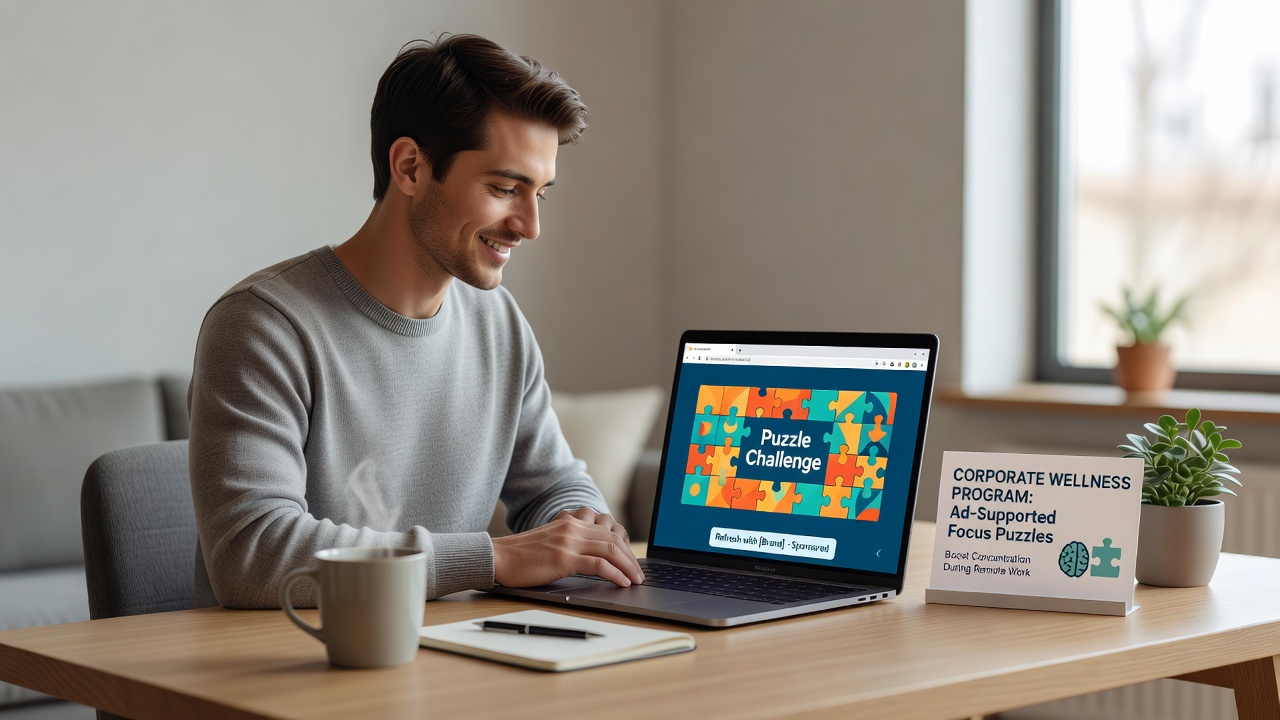
Corporate wellness programs have started integrating ad-supported browser puzzles into daily routines for remote employees, and these tools aim to sustain attention spans during scheduled work intervals while companies track participation metrics across multiple platforms. Observers note that such approaches emerged as organizations adapted to distributed teams after 2020, with program coordinators selecting short puzzle formats that load directly in standard browsers without requiring downloads or accounts. Data from workforce studies show participation rates climbing steadily as firms pair these activities with scheduled micro-breaks, and figures reveal that sessions typically last between three and seven minutes to align with attention restoration principles documented in cognitive research.
Integration Patterns Across Organizations
Human resources departments at mid-sized technology firms and financial service providers began piloting these puzzles in wellness portals during 2024, while larger enterprises scaled similar features by October 2026 following internal audits that linked brief mental resets to sustained output on collaborative platforms. Coordinators embed the puzzles within existing employee assistance dashboards, and the ad-supported model offsets licensing costs so that budgets remain focused on broader health initiatives such as ergonomic assessments and mental health resources. Employees access the activities through secure single-sign-on systems, and usage logs indicate peak engagement occurs mid-morning and early afternoon when remote schedules feature dense meeting blocks.
Research Findings on Focus and Productivity
Studies conducted by university teams in Australia and Canada have examined how ad-supported browser puzzles influence sustained attention, and results indicate measurable improvements in task-switching accuracy after short puzzle intervals compared with unstructured breaks. Researchers tracked cohorts across six-month periods, and the data demonstrate that participants who completed two to three puzzle sessions per day reported lower rates of afternoon fatigue on standardized self-assessment scales. A 2025 report released by the Public Health Agency of Canada highlighted correlations between structured micro-break activities and reduced absenteeism claims in remote cohorts, while analysts at the University of Melbourne documented similar patterns in longitudinal surveys of hybrid workers. These findings appear in peer-reviewed journals that emphasize objective performance measures over self-reported satisfaction alone.
Implementation Examples From Multiple Sectors
One logistics company based in the European Union introduced puzzle modules into its remote wellness application during the second quarter of 2025, and internal dashboards recorded a 12 percent rise in completed focus intervals among distributed drivers and planners. Another case involved a Canadian insurance provider that embedded puzzle links within its October 2026 wellness campaign, resulting in documented increases in voluntary break compliance tracked through the platform. Program administrators report that puzzle selection algorithms prioritize spatial reasoning and pattern-matching formats because prior laboratory trials linked these mechanics to quicker cognitive recovery, and the ad-supported delivery ensures continuous updates without additional subscription fees. Transition support includes brief onboarding videos that explain session timing, and compliance teams monitor aggregate usage to adjust recommendations for different time zones.
Technical and Privacy Considerations
Developers design the browser puzzles to function across desktop and mobile environments with responsive layouts, and encryption protocols protect session data that flows between employee devices and central wellness servers. Organizations often partner with third-party providers that maintain compliance with regional data regulations, and audit trails allow privacy officers to verify that no personally identifiable information transfers through the ad network. In October 2026 several firms updated their internal policies to require explicit consent toggles before puzzle sessions begin, and usage statistics indicate that most employees leave these settings enabled once they understand the data handling procedures. Network administrators confirm that the lightweight puzzle files load efficiently even on standard corporate VPN connections, and fallback modes exist for lower-bandwidth regions.
Measurement Approaches and Outcome Tracking
Wellness teams combine puzzle completion rates with productivity indicators such as project milestone adherence and error rates in shared documents, and aggregated reports help leadership evaluate return on wellness investments. External consultants sometimes conduct randomized controlled trials within participating departments, and early results align with patterns observed in earlier workplace intervention literature. Figures from industry surveys released in late 2025 show that companies allocating portions of their wellness budgets to digital micro-break tools experienced stable retention numbers during periods of high remote-work intensity. These measurement frameworks continue to evolve as new analytics integrations become available through existing human capital management systems.
Conclusion
Corporate wellness programs that incorporate ad-supported browser puzzles represent one documented response to the demands of remote work intervals, and available data from multiple regions illustrate how organizations track both participation and performance outcomes. Continued monitoring through October 2026 and beyond will clarify long-term patterns as more firms adopt similar structured break formats within their existing health frameworks.